ParliMeter is ready for 2026 – and looking back on 2025

ParliMeter is a parliamentary information, accountability and transparency platform that advocates for improved quality and access to parliamentary data.
As ParliMeter prepares for 2026, we take a look back at some of the highlights from 2025
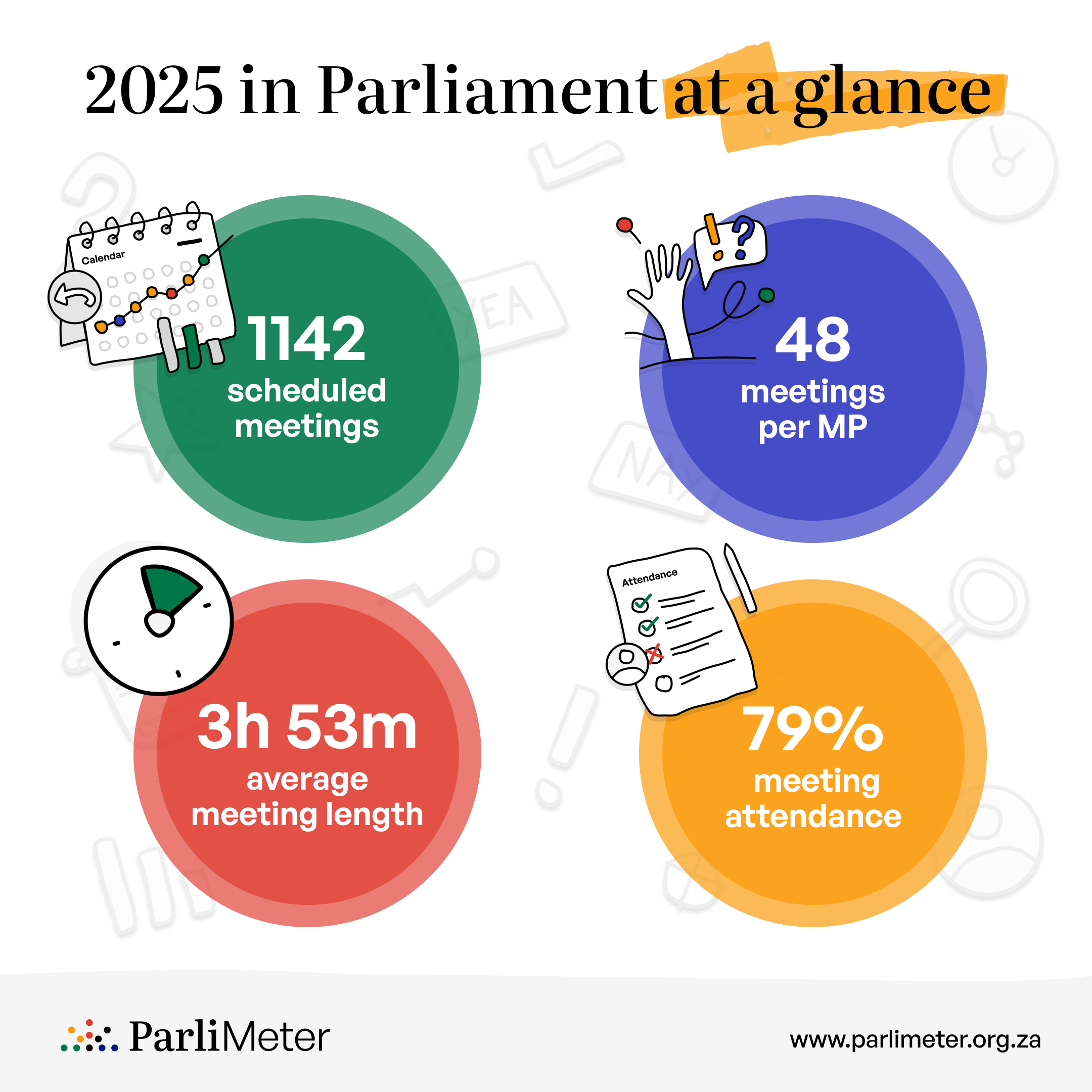
The ParliMeter Dashboard will celebrate its first birthday in 2026 after going live in March 2025. A collaboration between OpenUp, the Organisation for Undoing Tax Abuse (OUTA), and the Parliamentary Monitoring Group (PMG), ParliMeter makes it easy for South African citizens to access data that provides insight into parliamentary meetings, activities, and oversight. By taking a closer look at key statistics and outliers from 2025, we can gain a clearer understanding of how our elected Members of Parliament (MPs) spend their time and what gets prioritised.
Before we delve into the standout contenders of the year, let’s have a look at some quick stats.
Party attendance
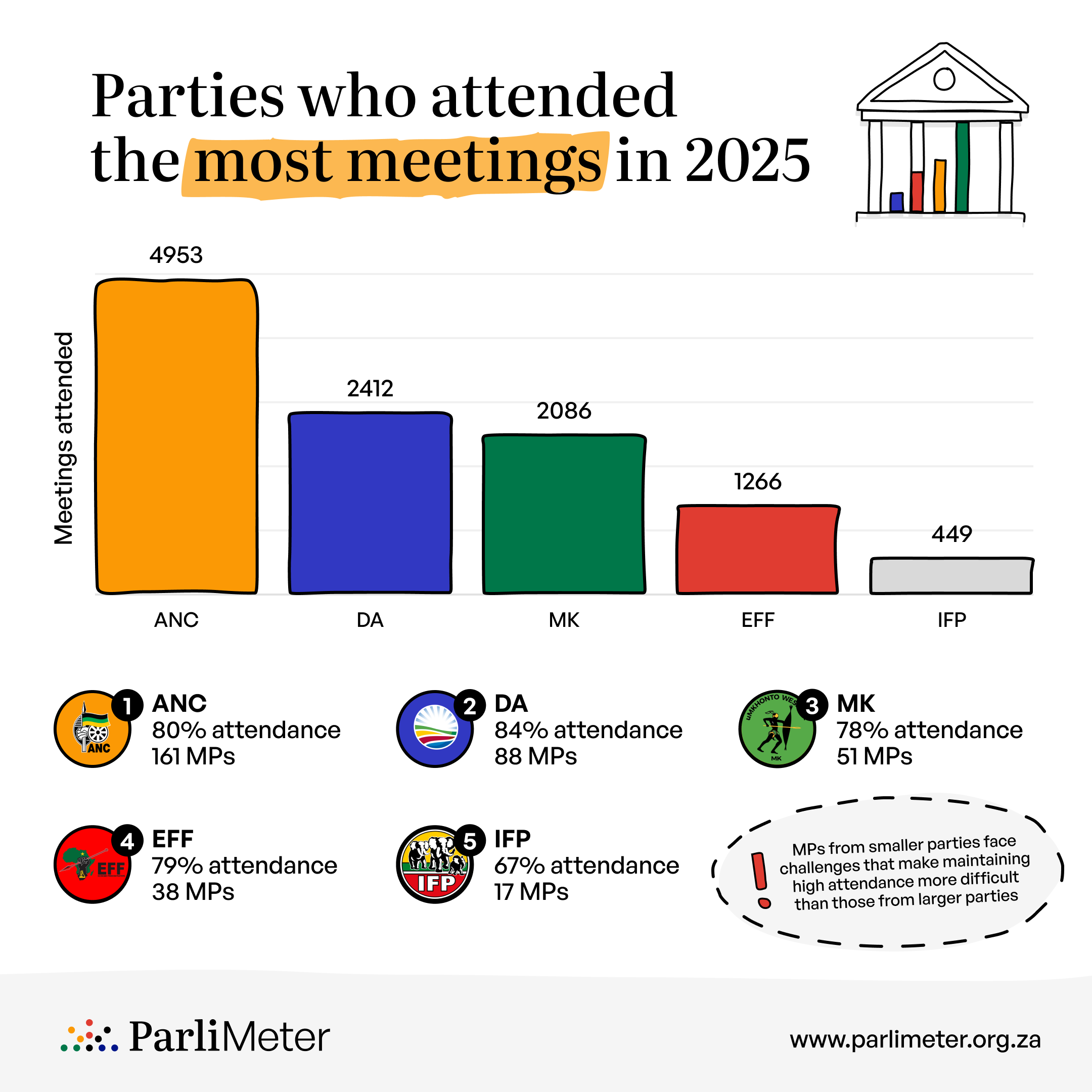
In a proportionally representative system, parties with more votes are assigned more seats in Parliament, as seen in party representation in the National Assembly (NA). This leaves large parties like the African National Congress (ANC) with 159 MPs in the NA, while most smaller parties only consist of one or two MPs.
“Smaller parties have fewer members to be distributed, hence they need to prioritise committees where they feel they can achieve the most impact,” says Dr Rachel Fischer, Parliamentary Engagement and Research Manager at OUTA.
Smaller parties have fewer members to be distributed, hence they need to prioritise committees where they feel they can achieve the most impact
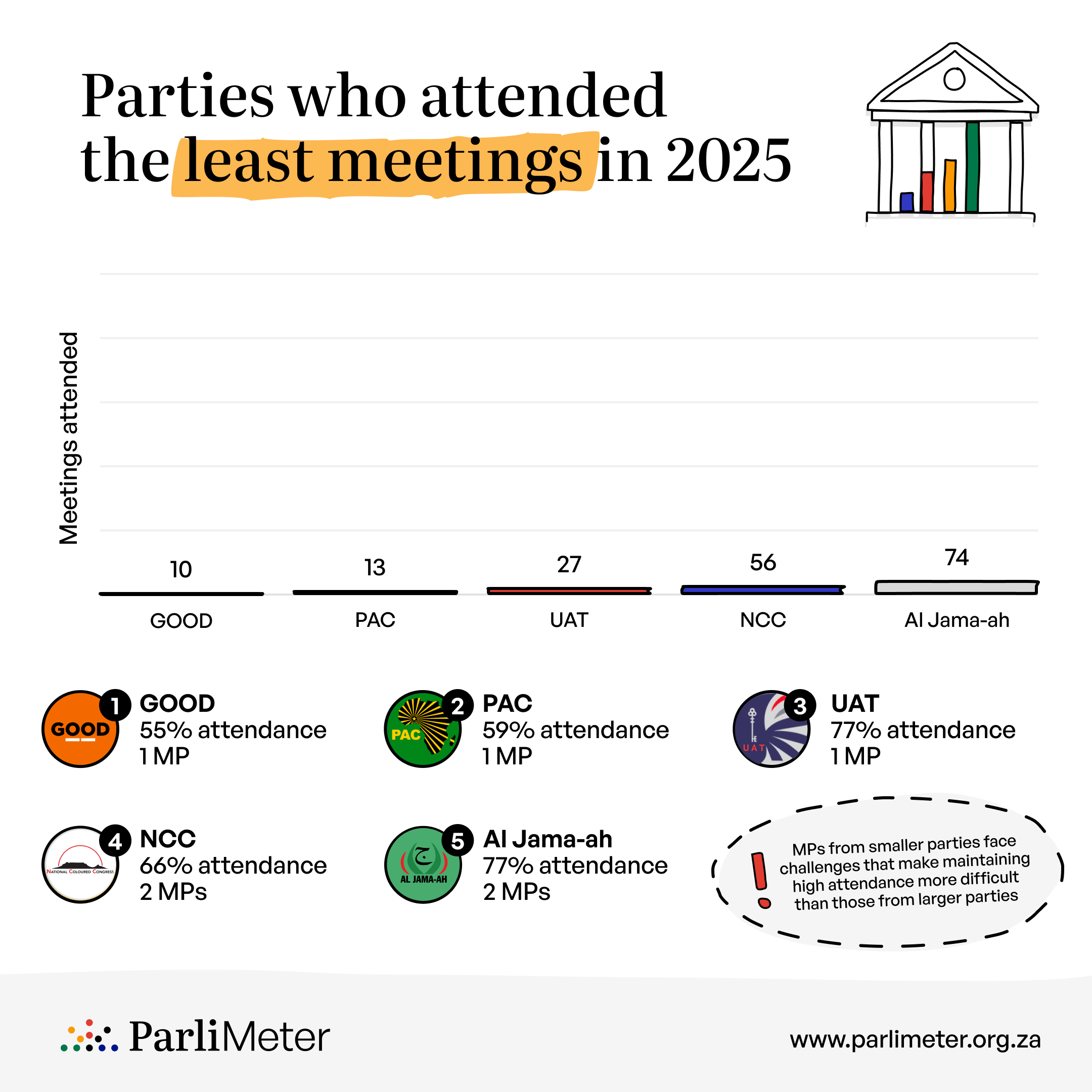
The five parties with the lowest rates of member attendance in 2025 all have either one or two members represented in Parliament, illustrating how a lack of members can lead to diminished opportunity to participate.
Some parties have members who occupy ministerial or deputy ministerial positions, which means their attendance and contribution is not accurately reflected in statistics regarding MP performance. For example, Patricia de Lille, who is the only parliamentary representative of the GOOD party, is the Minister of Tourism. Committee meeting attendance would therefore not reflect her ministerial attendance.
Members who submitted the most questions
MPs submitted over 7300 questions to various Cabinet Ministers and the President in 2025. Question submission is an important mechanism for accountability within the executive branch of government.
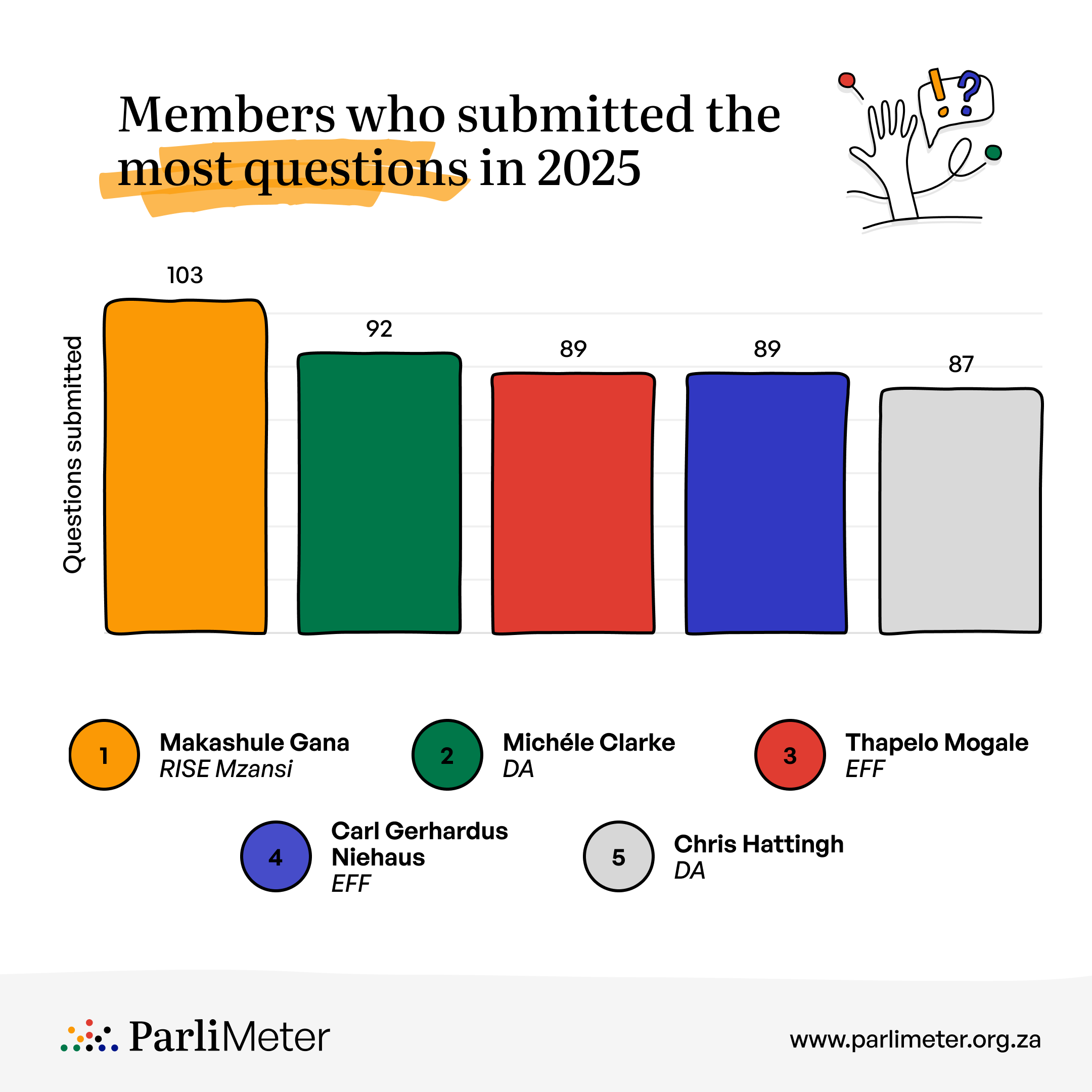
Makashule Gana, a Member of the NA and chief organiser for the RISE Mzansi party, submitted 103 questions in 2025, demonstrating that members from smaller parties can play active roles in broader parliamentary dialogue and activities despite their size.
“With two members in Parliament, we use questions to gain insights and hold ministers accountable in the [portfolio committee meetings] that we are not able to attend,” says Makashule Gana.
With two members in Parliament, we use questions to gain insights and hold ministers accountable in the [portfolio committee meetings] that we are not able to attend
Meetings per committee
“Portfolio committees are seen as the engine rooms of Parliament,” says Fischer. “Put bluntly, failure to attend and engage meaningfully has a direct impact on the citizens of South Africa, where – if not represented with integrity and care – their daily needs and lived realities are ignored.”
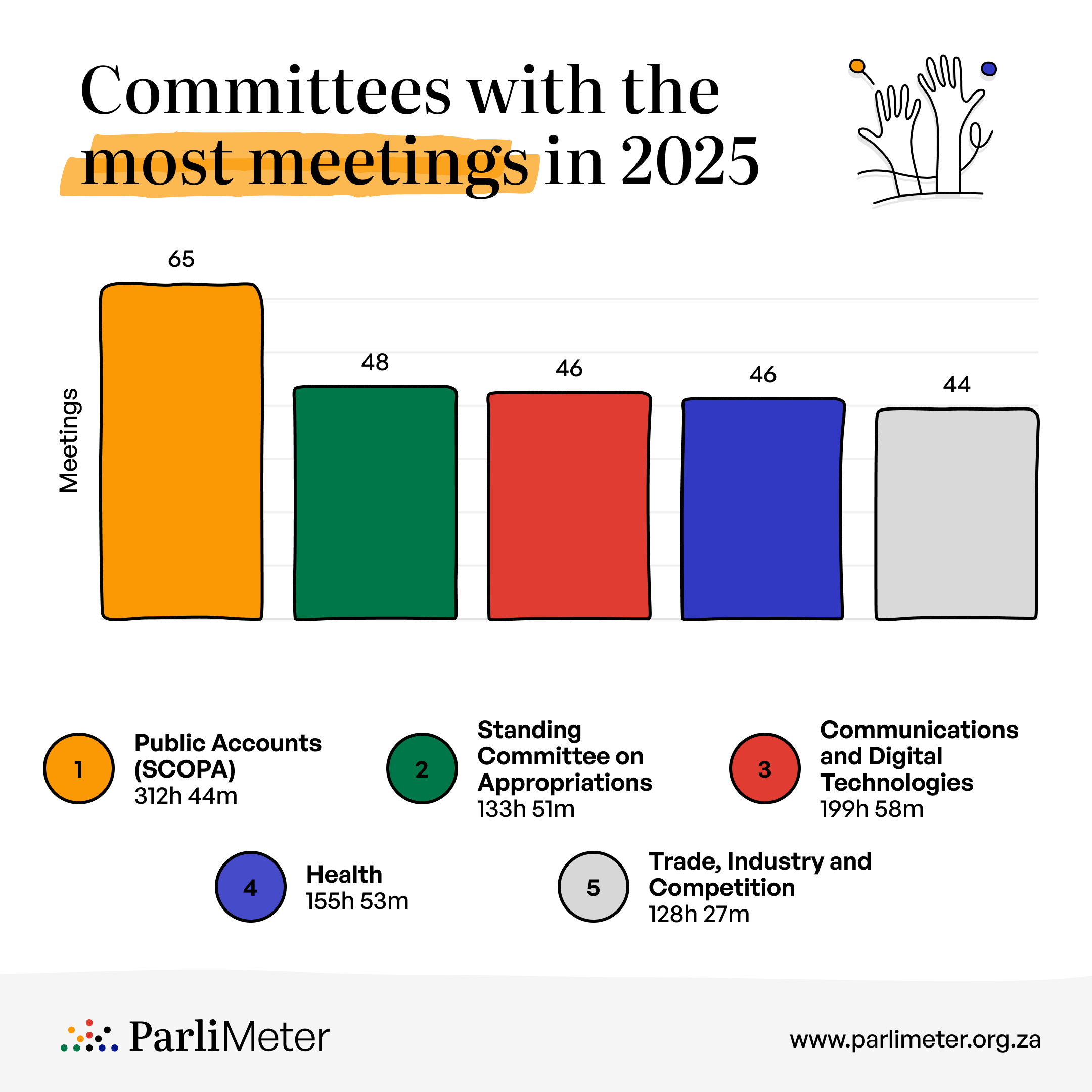
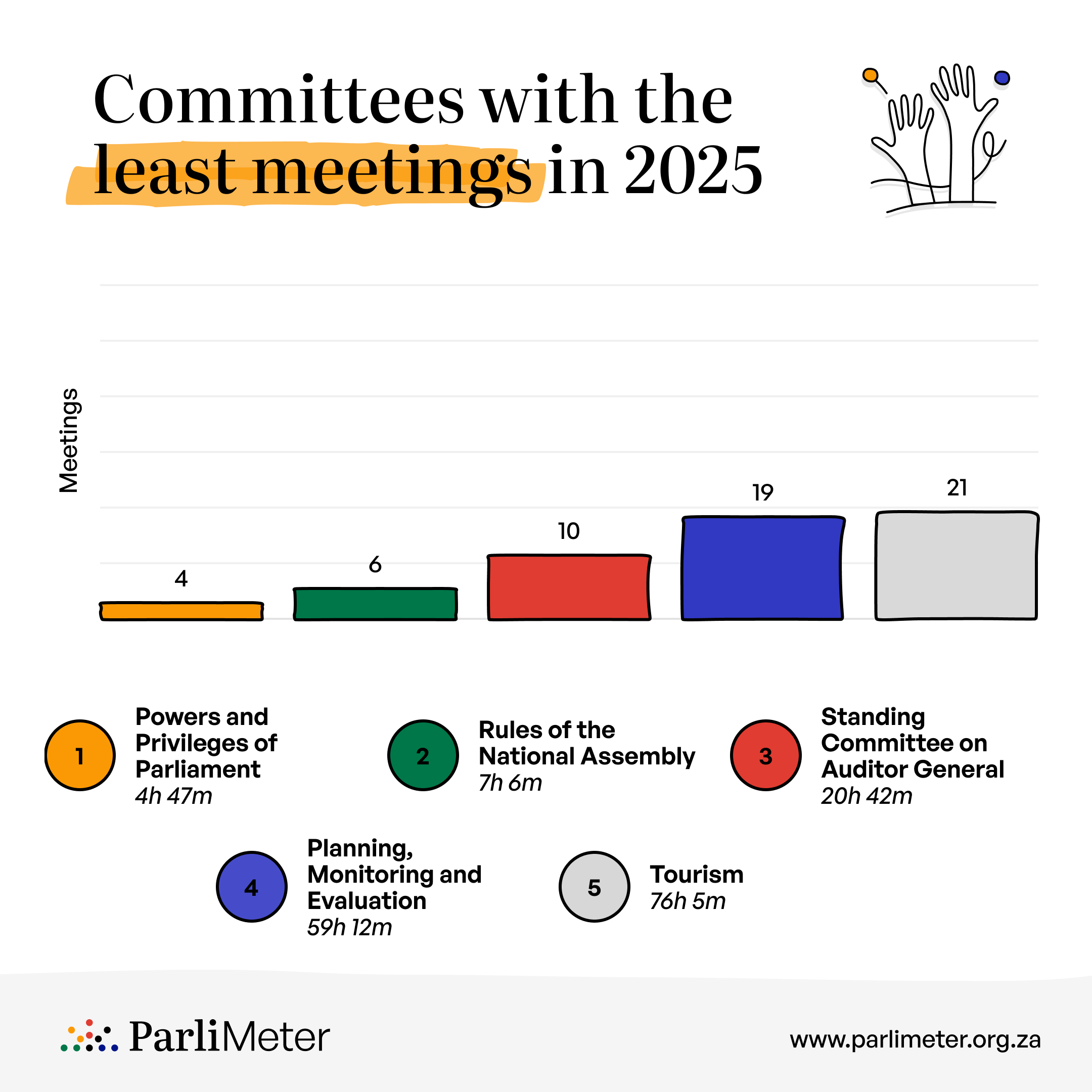
Parliamentary committees held an average of 30 meetings per committee throughout 2025. At number one, the Standing Committee on Public Accounts (SCOPA) convened 65 meetings over the year, with a notable increase in total meeting time following the commencement of its inquiry into the financial governance of the Road Accident Fund (RAF) in October.
“All things considered, one might argue [portfolio committees] do not meet enough, in consideration of the scope of issues to be dealt with,” says Fischer. “Most [portfolio committees] meet once a week for a couple of hours, and do not necessarily achieve – in depth and meaningfully – the outcomes required.”
Committee attendance
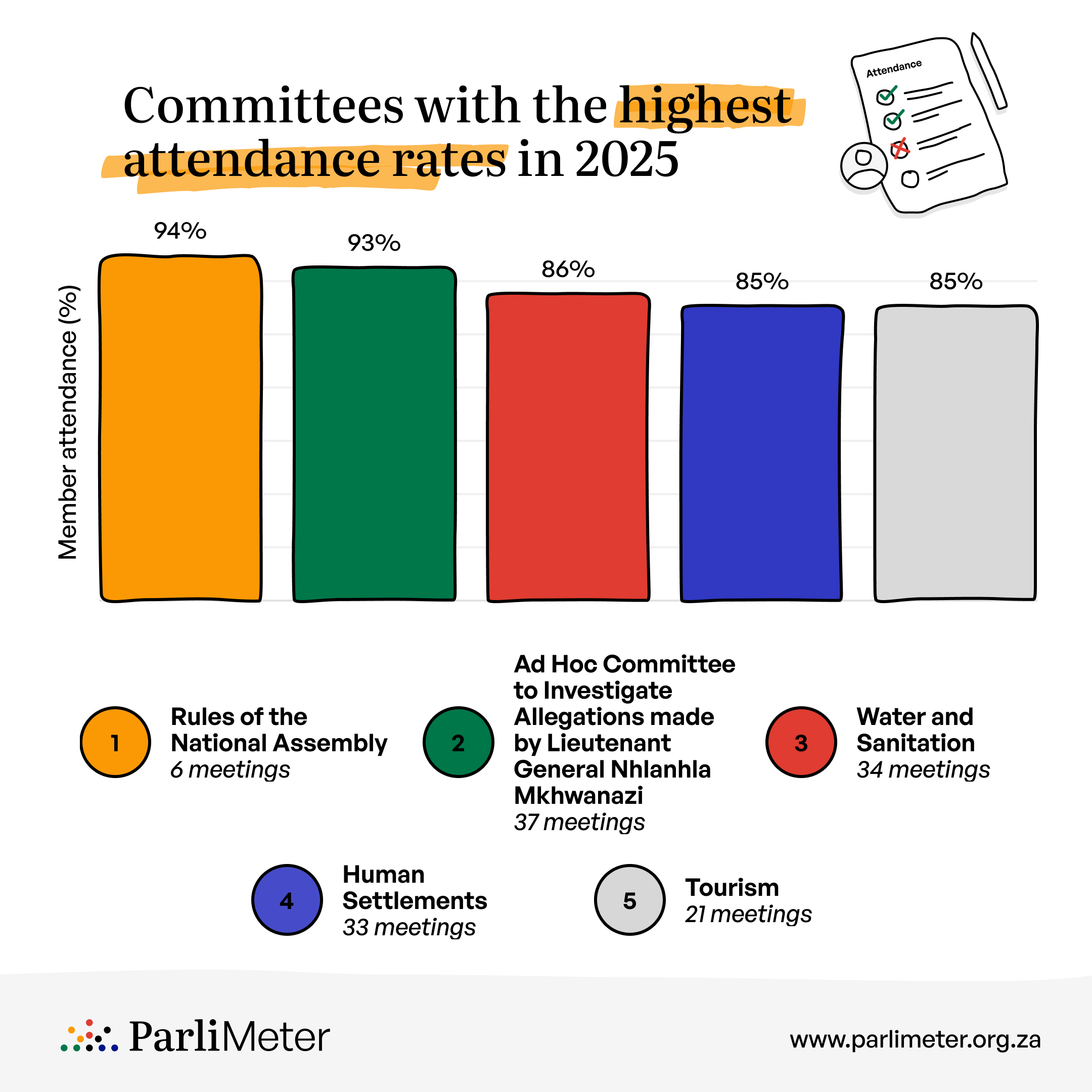
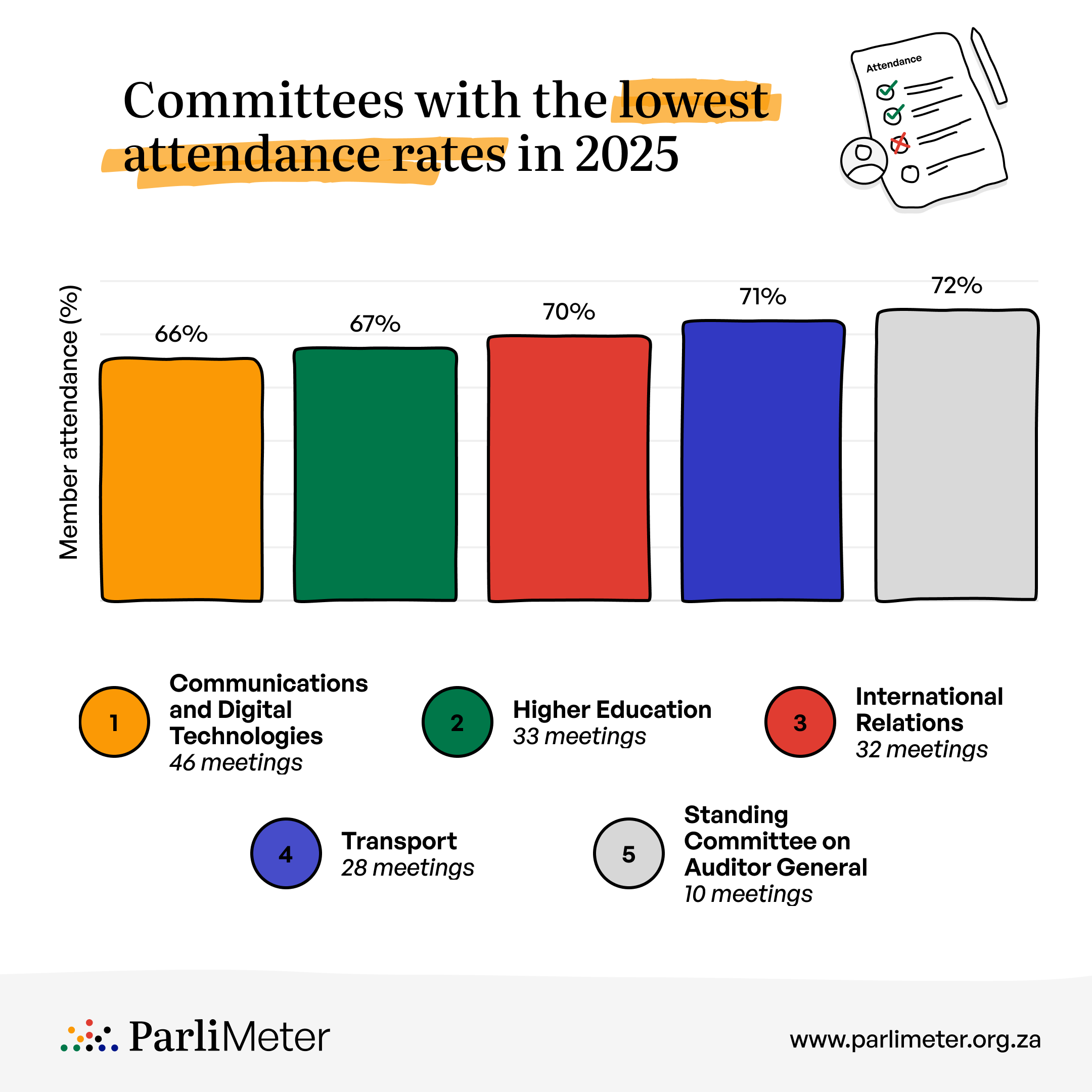
Despite high numbers of scheduled meetings, member attendance often varies across different committees. The Ad Hoc Committee to Investigate Allegations made by Lieutenant General Nhlanhla Mkhwanazi started its hearings on alleged corruption and infiltration of South African law enforcement operations in October 2025. With 11 members representing different parties and 37 scheduled meetings in the year, the committee managed to uphold a 93% member attendance rate.
“It is important to note that special inquiries and ad hoc committee meetings are established with good reason, and should therefore be attended to as best possible,” says Fischer.
Despite holding the second-highest number of meetings in 2025, the Communications and Digital Technologies Portfolio Committee had the lowest attendance rate at 66%.
“The starting point is attendance,” says Gana. “You can’t hold the executive accountable unless you are in attendance.”
Evaluating meeting attendance rates makes up only one, relatively simple way of measuring party and MP performance in Parliament. Other factors, such as the quality of contributions, level of engagement, sponsoring debates, initiating legislation, using all available tools to scrutinise government performance and follow-up on committee work, are more difficult to assess and quantify consistently.
In 2026, South Africa’s seventh Parliament is entering its third year and will be facing the first Local Government Elections (LGEs) since the inauguration of the Government of National Unity (GNU). Although Parliament is a national body and not directly involved in LGEs, the elections will affect parliamentary schedules as MPs will be allocated time to campaign and do constituency work at a local level. ParliMeter recently launched an interactive map that can be used to locate your nearest constituency office and relevant contact details.
However, reliable, consistent information regarding the specifics of when, where, and how MPs address constituency work varies greatly from party to party, as some parties do not necessarily adhere to parliamentary guidelines on publicising relevant internal documents. This is an issue that ParliMeter will be exploring further in 2026, as citizen interaction with MPs plays an integral role in ensuring accountability in government.
.png)
.png)


Work with us
We are looking for resource and data partners!
If you or your organisation would like to contribute or collaborate, please get in touch.
You might also like
From parliamentary data to public action: ParliMeter enters its next chapter
Women’s Month 2026: Are South Africa’s democratic institutions delivering on gender equality?